 by Webmaster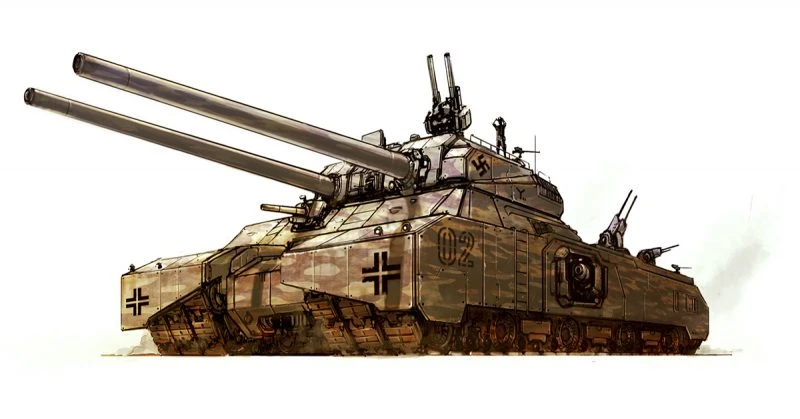
Give an overview on the hypothetical “Ratte” tank.
The “Ratte” was a super-heavy tank project proposed by Nazi Germany during World War II. The name “Ratte” means “rat” in German, and it was also known as the P1000, a reference to its supposed weight of 1000 tonnes.
The tank was designed to be 35 meters long, 14 meters wide, and 11 meters tall, making it the largest tank ever proposed. It was intended to be armed with two 280mm naval guns and multiple machine guns, and could be operated by a crew of up to 30 people.
However, the “Ratte” was never built, and it is unclear whether the project ever progressed beyond the initial design phase. There were several reasons for this, including a shortage of resources, the prioritization of other military projects, and the fact that the tank’s immense size and weight would have made it difficult to transport and operate.
Despite its failure to materialize, the “Ratte” has become a popular subject of speculation and fascination among military historians and enthusiasts, and is often featured in video games, movies, and other media as a symbol of the extremes of military engineering.
Elaborate on the tank designs difficulty to transport and operate.
The “Ratte” tank’s immense size and weight would have presented significant challenges for transport and operation, making it an impractical design for practical military use. Here are some of the specific issues:
- Transport: The tank’s sheer size and weight would have made it difficult to transport, even by rail or road. It would have required specially constructed transporters and infrastructure to move it around, which would have been a logistical nightmare.
- Mobility: Even if the “Ratte” could be transported to the battlefield, its weight and size would have made it very difficult to maneuver. The tank would have required a very large turning radius and could easily get stuck in mud or soft terrain, making it a liability on the battlefield.
- Crew: The “Ratte” would have required a very large crew to operate, with some estimates putting the number at up to 30 people. This would have made it difficult to coordinate and manage, and would have required a lot of training and resources.
- Cost: The “Ratte” was an extremely expensive design, and would have required vast amounts of resources to build and operate. Given the other priorities facing Nazi Germany during World War II, it is unlikely that the resources required to build the “Ratte” would have been allocated to such a single, impractical project.
Overall, while the “Ratte” may have been an impressive design on paper, its size and weight would have made it a difficult and impractical tank to transport and operate on the battlefield, ultimately rendering it an unrealistic and unfeasible military weapon.
How would a ‘Ratte’ tank fare in the 2020s Russia-Ukraine war?
It is difficult to say how a hypothetical “Ratte” tank would fare in the 2020s Russia-Ukraine war as the design was never realized and its capabilities are largely speculative. However, given the significant disadvantages posed by the tank’s size and weight, it is unlikely that it would be an effective weapon in modern warfare.
Modern tanks are designed to be highly mobile, with a low profile and high maneuverability. They are also equipped with advanced weapons systems and defenses, including active protection systems, advanced armor, and precision-guided munitions. In contrast, the “Ratte” was a stationary, slow-moving behemoth that would be vulnerable to attacks from modern anti-tank weapons and artillery.
Furthermore, the logistical challenges of transporting and operating the “Ratte” would make it difficult to deploy in the fast-moving, fluid battlefield environment that characterizes modern warfare. The tank’s size and weight would make it a liability, particularly in urban environments, where it would be difficult to maneuver and could cause significant damage to infrastructure.
Overall, while the “Ratte” may have been an impressive design in its time, it is unlikely that it would be a practical or effective weapon in modern warfare, particularly in the context of the 2020s Russia-Ukraine war.
List a number of effective countermeasures which would easily immobilize or destroy a Ratte tank in the Russia-Ukraine conflict.
As a hypothetical design that was never built, the “Ratte” tank does not have specific vulnerabilities or countermeasures that can be identified. However, given its size and weight, as well as the capabilities of modern anti-tank weapons and tactics, it is likely that the “Ratte” would be vulnerable to a number of countermeasures in the context of the Russia-Ukraine conflict. Here are some examples:
- Anti-tank missiles: Modern anti-tank missiles, such as the Javelin and the TOW, are highly effective against armored vehicles. They use infrared guidance systems and can be fired from a safe distance, making them a potent threat to a slow-moving, immobile target like the “Ratte.”
- Artillery: Heavy artillery and mortars can be used to target the “Ratte” from a distance, taking advantage of its large size and lack of mobility to land accurate shots.
- Aerial bombardment: A large, stationary target like the “Ratte” would be vulnerable to aerial bombardment from fighter jets or bombers.
- Sabotage: Sabotage could be used to disable or destroy the “Ratte” in its transport or operational phases. For example, a bomb or improvised explosive device (IED) could be placed on the tank’s transport vehicle or in the vicinity of the tank itself.
- Urban warfare: The “Ratte” would be difficult to maneuver in urban environments, where its size and weight could cause significant damage to infrastructure and make it vulnerable to attacks from above, such as RPGs fired from rooftops.
Overall, while the “Ratte” was never built and its vulnerabilities cannot be definitively established, its size and lack of mobility would likely make it vulnerable to a range of countermeasures in the context of modern warfare.


Leave a Reply