 by Webmaster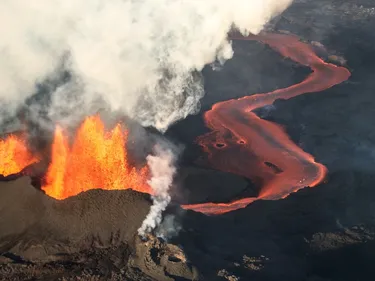
Summarize the Krakatoa volcanic eruption of 1883.
The Krakatoa volcanic eruption of 1883 was one of the most catastrophic volcanic events in history. It occurred on the Indonesian island of Krakatoa and lasted from August 26th to August 27th. The eruption was caused by the movement of tectonic plates in the area, which triggered a series of volcanic explosions and earthquakes.
The eruption was so powerful that it was heard as far away as Perth, Australia, and the sound waves were recorded on barographs around the world. The explosions generated tsunamis that reached heights of up to 130 feet and devastated the coastlines of Java and Sumatra, killing tens of thousands of people.
The eruption also caused a massive ash cloud that covered the Earth’s atmosphere, causing global climate changes that lasted for several years. The ash and debris ejected by the eruption also caused beautiful sunsets around the world, as the particles scattered the sunlight and created a red and orange hue in the sky.
Overall, the Krakatoa eruption of 1883 is considered one of the deadliest and most destructive volcanic events in history, with an estimated death toll of over 36,000 people.
What would the death toll and property damage be like now if the Krakatoa eruption occurred in 2023? Considering the vast increases in population in Java and Sumatra etc.
It is difficult to estimate the potential death toll and property damage that would result from a Krakatoa-like eruption occurring in 2023 due to the complex and dynamic nature of such an event. However, we can assume that the increased population and infrastructure in the affected regions could significantly exacerbate the impact of the eruption.
For example, the current population of Java and Sumatra combined is estimated to be around 230 million people, which is much higher than the estimated population of the region at the time of the 1883 eruption. A similar eruption could result in a much higher death toll due to the increased population density and urbanization in the area.
In addition, the potential for property damage could also be significant, given the expansion of cities and infrastructure in the affected regions. The tsunamis generated by the eruption could cause widespread destruction of buildings and infrastructure along the coastlines of Java and Sumatra, leading to significant economic and social impacts.
Overall, the potential impact of a Krakatoa-like eruption in 2023 would depend on a range of factors, including the size and intensity of the eruption, the location and population density of the affected regions, and the preparedness and response capabilities of the local authorities and communities.
Describe the sound emission of the Krakatoa eruption. How was it heard as far away as Perth in Australia?
The sound emission of the Krakatoa eruption was one of the most remarkable aspects of the event. The eruption generated a series of incredibly loud and powerful explosions that could be heard over an area of more than 3,000 miles (4,800 km) from the volcano, including as far away as Perth, Australia, which is more than 2,000 miles (3,200 km) from Krakatoa.
The sound waves generated by the eruption were so powerful that they traveled around the world multiple times, and could be detected on barometers as far away as England and the United States. The sound was described by witnesses as a series of loud explosions, followed by a deep and prolonged rumbling sound that lasted for several hours.
The reason why the sound of the Krakatoa eruption traveled so far is due to the unique acoustic properties of the Earth’s atmosphere. Sound waves can travel much farther and more efficiently through the upper atmosphere than through the denser lower atmosphere, which is closer to the Earth’s surface.
In addition, the eruption also generated a massive air pressure wave that propagated through the atmosphere, which helped to carry the sound even farther. This air pressure wave was responsible for the destruction of buildings and other structures in the surrounding area, as well as the generation of the tsunamis that caused widespread devastation along the coasts of Java and Sumatra.
Overall, the sound emission of the Krakatoa eruption was one of the most incredible natural phenomena in human history, and its impact was felt across the globe.
Describe the acoustic pressure wave which circled the globe more than three times.
The acoustic pressure wave created by the Krakatoa eruption was so powerful that it was able to travel around the entire globe more than three times. This is known as a “pressure wave” or “sound wave”, which is a type of disturbance that travels through a medium, such as air, as a series of compressions and rarefactions.
When the volcano erupted, it produced an enormous amount of energy in the form of heat, ash, and gas. This energy was released in a sudden and violent explosion that created a shock wave that traveled through the atmosphere. As the shock wave moved through the air, it caused the air molecules to compress and then expand, creating a wave of pressure that moved outward from the eruption site.
The pressure wave continued to travel through the air, bouncing off the upper atmosphere and returning to the earth’s surface multiple times. This allowed it to travel around the globe multiple times before finally dissipating. The pressure wave was so powerful that it was measured by barometers all over the world, and its effects were felt as far away as the Indian Ocean, Africa, Australia, and South America.
Overall, the acoustic pressure wave created by the Krakatoa eruption was an incredible display of the power of nature and remains one of the most significant geological events in human history.
What would the sound have been like in decibels depending upon a persons proximity to the Krakatoa eruption?
The sound level of the Krakatoa eruption varied depending on a person’s proximity to the volcano. The sound level of an explosion decreases with distance, so people closer to the volcano would have experienced much louder sounds than those farther away.
At a distance of 100 miles (160 km) from the volcano, the sound level of the eruption was estimated to be around 172 decibels (dB), which is well above the threshold of pain for the human ear and can cause immediate and permanent hearing damage.
At a distance of 10 miles (16 km) from the volcano, the sound level would have been around 190 dB, which is the loudest sound that can be generated in Earth’s atmosphere before it collapses into a vacuum. At this level, the sound would have been powerful enough to rupture eardrums, knock people off their feet, and even cause internal injuries.
For comparison, a typical conversation between two people is around 60 dB, while a jet engine at takeoff is around 140 dB. The sound level of the Krakatoa eruption was so powerful that it was heard over an area of more than 3,000 miles (4,800 km) from the volcano, and could be detected on barometers as far away as England and the United States.
Overall, the sound level of the Krakatoa eruption was one of the most remarkable aspects of the event, and it serves as a testament to the incredible power and destructive force of volcanic eruptions.
Did many people in close distance to the Krakatoa eruption — say with 100 kilometers — suffer permanent hearing damage in addition to chronic Tinnitus?
It is possible that people who were within 100 kilometers of the Krakatoa eruption suffered permanent hearing damage and chronic tinnitus as a result of the loud sound emitted by the eruption. The sound level at this distance would have been around 170-180 decibels, which is well above the threshold of pain for the human ear and can cause immediate and permanent hearing damage.
However, there are no historical records of people suffering from permanent hearing damage or chronic tinnitus as a result of the Krakatoa eruption, so it is difficult to know for certain. It is possible that such cases went unrecorded or were attributed to other causes, such as the physical injuries and trauma that were inflicted by the tsunamis and other aspects of the eruption.
That being said, it is known that exposure to loud noises can cause temporary or permanent hearing loss, as well as chronic tinnitus, which is a ringing or buzzing sound in the ears that persists over time. These effects can be caused by a single loud noise exposure or by repeated exposure to loud noises over time.
Overall, while there is no definitive evidence that people within 100 kilometers of the Krakatoa eruption suffered permanent hearing damage or chronic tinnitus, it is certainly possible given the loud and powerful sound emitted by the eruption at this distance.
Compare the decibel levels of the Krakatoa eruption sound waves to various firearm calibers.
The decibel levels of the sound waves produced by the Krakatoa eruption were much higher than those of any firearm caliber. Here are some examples of the approximate decibel levels of various firearm calibers compared to the estimated decibel levels of the Krakatoa eruption at different distances:
I. A .22 caliber rifle produces a sound level of around 140 dB, which is loud enough to cause immediate hearing damage at close range. This is roughly equivalent to the sound level of a nearby lightning strike, but much lower than the sound level of the Krakatoa eruption at any distance.
II. A 9mm pistol produces a sound level of around 160 dB, which is much louder than a .22 caliber rifle but still well below the sound level of the Krakatoa eruption.
III. A 12-gauge shotgun produces a sound level of around 165 dB, which is closer to the estimated sound level of the Krakatoa eruption at a distance of 100 miles (160 km), but still lower than the sound level at closer distances.
IV. At a distance of 10 miles (16 km), the sound level of the Krakatoa eruption was estimated to be around 190 dB, which is the loudest sound that can be generated in Earth’s atmosphere before it collapses into a vacuum. This is much louder than any firearm caliber, and closer to the sound level of a large explosion or rocket launch.
Overall, the sound level of the Krakatoa eruption was much higher than any firearm caliber and is one of the loudest natural sounds ever recorded.
Wow. So the sound of the Krakatoa volcanic eruption at a distance of 160 kilometers was even louder — about 7 dB worth — to a 12-gauge shotgun blast at close range?
Yes, that’s correct. The estimated sound level of the Krakatoa volcanic eruption at a distance of 160 kilometers was around 172 decibels (dB), which is about 7 dB louder than the sound level of a 12-gauge shotgun blast at close range, which is typically around 165 dB.
This means that the sound of the Krakatoa eruption at that distance was even more intense and potentially damaging to human hearing than a 12-gauge shotgun blast at close range, which is already extremely loud and can cause immediate and permanent hearing damage.
Leave a Reply