 by Webmaster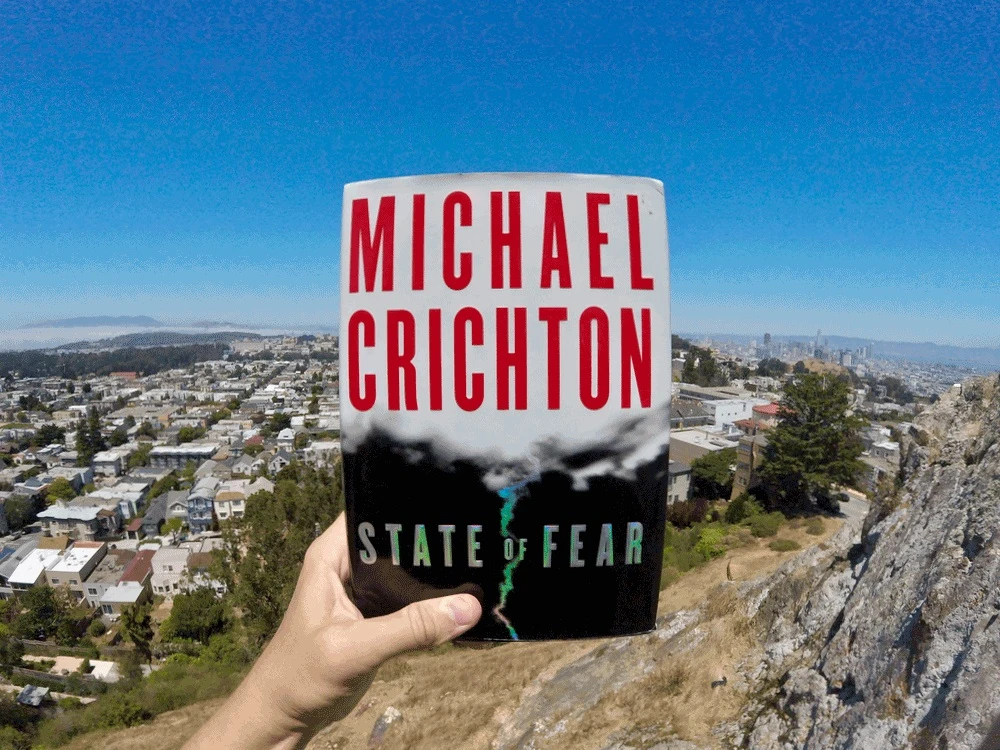
Give a summary of the Michael Crichton book ‘State of Fear’ from 2004.
As the story progresses, Evans uncovers a plot by a radical environmental group, the National Environmental Resource Fund (NERF), to manipulate data on climate change in order to create a sense of panic and raise money for their cause. Evans joins forces with an eccentric billionaire and his team of adventurers to stop NERF from carrying out a catastrophic attack on a conference of world leaders.
Throughout the novel, Crichton presents arguments against the theory of man-made global warming, suggesting that it is based on faulty science and political agendas. He also critiques the media’s role in shaping public opinion on environmental issues and highlights the danger of blindly accepting scientific consensus.
The book was controversial upon its release, with many critics accusing Crichton of promoting climate change denial and misrepresenting the science. However, the novel was also praised for its thrilling plot and thought-provoking ideas on the role of science in society.
What did the eco-terrorist group NERF intend to do to manipulate the data on climate change?
In the novel “State of Fear” by Michael Crichton, the eco-terrorist group NERF (National Environmental Resource Fund) intends to manipulate the data on climate change to create a sense of panic and raise money for their cause. They plan to do this by artificially creating natural disasters such as earthquakes, tsunamis, and other extreme weather events, which they would then blame on global warming.
The group aims to manipulate public perception and generate funding for their cause by spreading fear and creating a sense of urgency around climate change. Ultimately, their goal is to increase their political power and influence.
What arguments against the theory of man-made global warming did Michael Crichton present in the book?
In the book “State of Fear” by Michael Crichton, the author presents several arguments against the theory of man-made global warming. These arguments include:
- The uncertainty of climate science: Crichton suggests that climate science is far from settled and that there is still much we don’t understand about the Earth’s climate system. He argues that models used to predict future climate change are based on incomplete data and unproven assumptions.
- The role of natural climate variability: Crichton points out that the Earth’s climate has always been subject to natural variability, such as changes in solar radiation, ocean currents, and volcanic activity. He suggests that attributing all climate change to human activity is overly simplistic and ignores the role of natural factors.
- The influence of politics and ideology: Crichton argues that the debate around climate change is often influenced by political and ideological biases rather than scientific evidence. He suggests that some scientists and environmental activists have a vested interest in promoting the idea of man-made global warming, even if the evidence does not support it.
- The potential benefits of warming: Crichton suggests that there may be some benefits to a warmer climate, such as increased agricultural productivity and a reduction in cold-related deaths.
It should be noted that while these arguments are presented in the book, they have been criticized by many scientists and experts as being inaccurate or misleading.
Elaborate more on his critiques of the media’s role in shaping public opinion on environmental issues, and highlights the danger of blindly accepting scientific consensus.
In “State of Fear,” Michael Crichton also critiques the media’s role in shaping public opinion on environmental issues, particularly the issue of global warming.
He argues that the media tends to sensationalize environmental stories, emphasizing worst-case scenarios and downplaying or ignoring scientific uncertainty. He suggests that this approach can lead to public panic and pressure for action that may not be based on sound science.
Crichton also highlights the danger of blindly accepting scientific consensus. He suggests that scientific consensus is not always based on a rigorous evaluation of the evidence and can be influenced by political or ideological biases. He argues that scientific progress often depends on challenging existing theories and evidence, and that the scientific consensus should be continually questioned and re-evaluated.
Crichton’s critiques of the media and scientific consensus are part of a broader argument in the book that environmental issues are often politicized and subject to manipulation by special interest groups.
He suggests that a more nuanced and rational approach is needed to address environmental issues, one that is based on sound science and an honest evaluation of the risks and benefits of different policy options.
It should be noted that Crichton’s critiques of the media and scientific consensus have been controversial and have been criticized by some as promoting a distrust of science and expertise. However, his arguments have also been influential in shaping the public debate on environmental issues and have led to a more critical evaluation of the role of the media and scientific consensus in shaping public opinion.
Elaborate more on the role of natural climate variability. The Earth has had many ‘global warming’ events such as the Cretaceous Hot Greenhouse (about 92 million years ago), and the Paleocene-Eocene Thermal Maximum (about 56 million years ago) without any human causes whatsoever.
In “State of Fear,” Michael Crichton argues that natural climate variability plays a significant role in shaping the Earth’s climate, and that attributing all climate change to human activity is overly simplistic. He points out that throughout Earth’s history, there have been many periods of warming and cooling, some of which were much more extreme than the current warming trend.
For example, as the user noted, the Cretaceous Hot Greenhouse and the Paleocene-Eocene Thermal Maximum were both periods of global warming that occurred millions of years ago, long before humans had any significant impact on the climate.
Crichton suggests that these periods of natural warming were caused by a variety of factors, including changes in solar radiation, volcanic activity, and the Earth’s orbit and tilt. He argues that attributing all climate change to human activity ignores the role of natural factors and oversimplifies a complex and poorly understood system.
Crichton’s argument is supported by many climate scientists who acknowledge the role of natural variability in shaping the Earth’s climate.
However, it is important to note that while natural variability can explain some climate change, the current warming trend is likely due to human activities such as the burning of fossil fuels and deforestation. The scientific consensus is that human activities are the primary cause of current global warming, but natural variability can still play a significant role in shaping the Earth’s climate on longer timescales.
It was a popular trend for Hollywood to make movie adaptations out of Michael Crichton books in the 1990s. Why was ‘State of Fear’ ignored in being given the big screen treatment?
There are several possible reasons why “State of Fear” was not given the big screen treatment despite the popularity of Michael Crichton’s books in Hollywood in the 1990s.
One reason could be the controversial nature of the book’s content. “State of Fear” is known for presenting arguments against the theory of man-made global warming, which is a topic that can be polarizing and contentious. Some studios or filmmakers may have been reluctant to take on a project that could be seen as politically or ideologically divisive.
Another possible reason could be the book’s reception. While “State of Fear” was a bestseller, it was not as well-received critically as some of Crichton’s other works. Some critics felt that the book was overly didactic and relied too heavily on arguments rather than plot and character development. This could have made it a less appealing prospect for filmmakers looking to adapt the book for the screen.
Finally, it is possible that there were simply no filmmakers or studios interested in adapting “State of Fear” at the time.
The process of developing a movie adaptation can be complex and involve many different factors, including the availability of funding, interest from talent, and scheduling conflicts. It is possible that these factors simply did not align in a way that made it feasible or desirable to bring “State of Fear” to the big screen.
“Some studios or filmmakers may have been reluctant to take on a project that could be seen as politically or ideologically divisive.”
Its very apparent that Hollywood is on board with the ‘climate change’ ideology. Would a film about this book be very damaging to their narrative?
It is possible that a film adaptation of “State of Fear” could be seen as politically or ideologically divisive and potentially damaging to the mainstream narrative on climate change. While Hollywood is often seen as liberal-leaning, the entertainment industry is also a business that depends on appealing to a wide audience and avoiding controversy that could damage its bottom line.
If a film adaptation of “State of Fear” were to present arguments against the theory of man-made global warming, it could be seen as going against the mainstream narrative and potentially alienating a significant portion of the audience. This could result in lower box office receipts and negative publicity for the studio and filmmakers involved.
However, it is important to note that Hollywood is not monolithic in its views on climate change or other political issues. While there may be a general trend towards progressive politics and environmental activism, there are also individuals and groups within the industry who hold different views and may be willing to take on controversial projects.
Ultimately, the decision to adapt “State of Fear” for the screen would likely depend on a variety of factors, including the availability of funding, interest from talent, and the overall viability of the project. While the book’s content could be seen as potentially divisive, it is possible that there could be filmmakers or studios willing to take on the challenge of adapting it for the screen.
Last question. Why is “climate change denial” such a smear?
The term “climate change denial” is considered by some to be a smear because it implies that those who question or dispute the scientific consensus on climate change are engaged in the same kind of denialism as those who deny well-established facts such as the Holocaust or the link between smoking and lung cancer.
In the case of climate change, the scientific consensus is that the Earth’s climate is warming due to human activities, particularly the burning of fossil fuels, and that this warming poses significant risks to human health, ecosystems, and economies. The overwhelming majority of climate scientists agree with this consensus view.
However, there are still some individuals and organizations who dispute or downplay the scientific consensus on climate change, often by misrepresenting or cherry-picking data, or by relying on flawed arguments. These individuals and organizations are often referred to as “climate change deniers.”
Some argue that the term “denier” is inappropriate or unfair because it implies a deliberate refusal to accept facts, and may also suggest a moral equivalence with Holocaust denial.
However, others argue that the term is appropriate because it accurately describes the behavior of those who deny or downplay the scientific consensus on climate change, and emphasizes the seriousness of the issue. Ultimately, the use of the term is a matter of debate, and different people may have different views on its appropriateness.
Leave a Reply